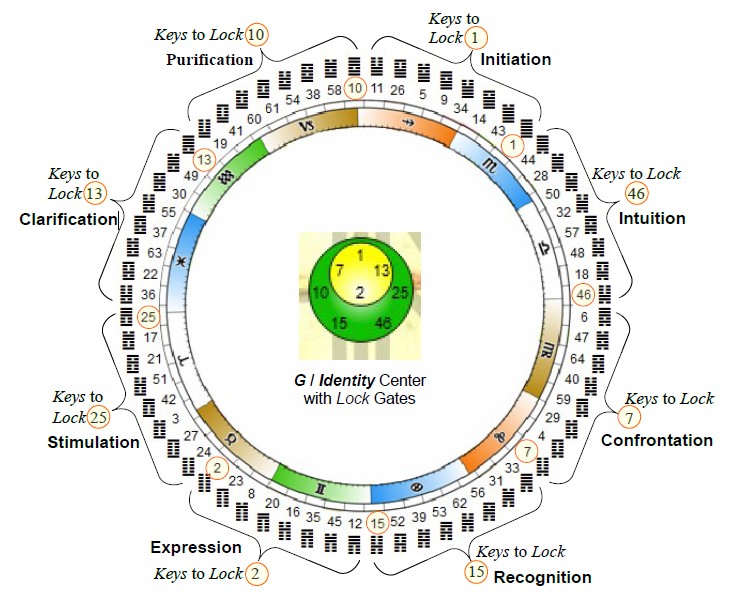
In the pattern being presented, the Key Hexagrams are grouped into sets of eight, with each of the Hexagrams having the same lower trigram pattern. Each group, composed of one-eighth of the Hexagram Zodiac, is associated with a single Lock Hexagram from within the group. Consequntly, there are a total of eight Lock Hexagrams/gates, identified as the gates in the G Center of the Bodygraph.
Trigram Keynotes
The 64 Hexagrams of the I’Ching are each composed of two Trigrams, a lower trigram and an upper trigram. The lower trigram is normally considered the internal or individual aspects of a hexagram. The upper trigram is considered the external or trans-personal aspects of the hexagram.
Below is a selection of keynotes, related to each of the common Lower Trigrams of the Hexagram Zodiac. Allow these keynotes to help broaden your understanding of of the Keys Hexagram characteristics as well. Notice too, that the Lock Hexagrams only have fully Yang (☰) or fully Yin (☷) Upper Trigrams.
| Lower Trigram |
Keyword | I’Ching Characteristics 1, 2, 3 | Hexagrams/Gates | |
|---|---|---|---|---|
| Lock | Keys | |||
| ☰ | Initiation | Creating (Initiating) Heaven, Conceptual, Potential, Yang | 1 (䷀) | 1, 43, 14, 34, 9, 5, 26,11 |
| ☱ | Purification | Satisfying (Joyous) Lake; Anticipation; Hope | 10 (䷉) | 10, 58, 38, 54, 61, 60, 41, & 19 |
| ☲ | Clarification | Arising Brightness, Clinging Fire; Hesitant | 13 (䷌) | 13, 49, 30, 55, 37, 63, 22, & 36 |
| ☳ | Stimulation | Arousing Thunder, Shock and Relief; Shakeup | 25 (䷘) | 25, 17, 21, 51, 42, 3, 27, 24 |
| ☷ | Expression | Adapting (Penetrating) Wind; Wood; Gentle Proceeding; Maturing, Yin | 2 (䷁) | 2, 23, 8, 20, 16, 35, 45, 12 |
| ☶ | Recognition | Still (Stable) Mountain; Boundaries; Resistance | 15 (䷎) | 15, 52, 39, 53, 62, 56, 31, 33 |
| ☵ | Confrontation | Exposing Canyon; Dangerous Water; Marsh; Transition | 7 (䷆) | 7, 4, 29. 59, 40, 64, 47, 6 |
| ☴ | Intuition | Adapting (Penetrating) Wind; Wood; Gentle Proceeding; Maturing | 46 (䷭) | 46, 18, 48, 57, 32, 50, 28, 44 |
References:
-
The Book of Changes, The Yijing, by Bradford Hatcher
-
The Numerology of the I’Ching, by Alfred Huang
-
The I’Ching Oracle, by Nigel Richmond